



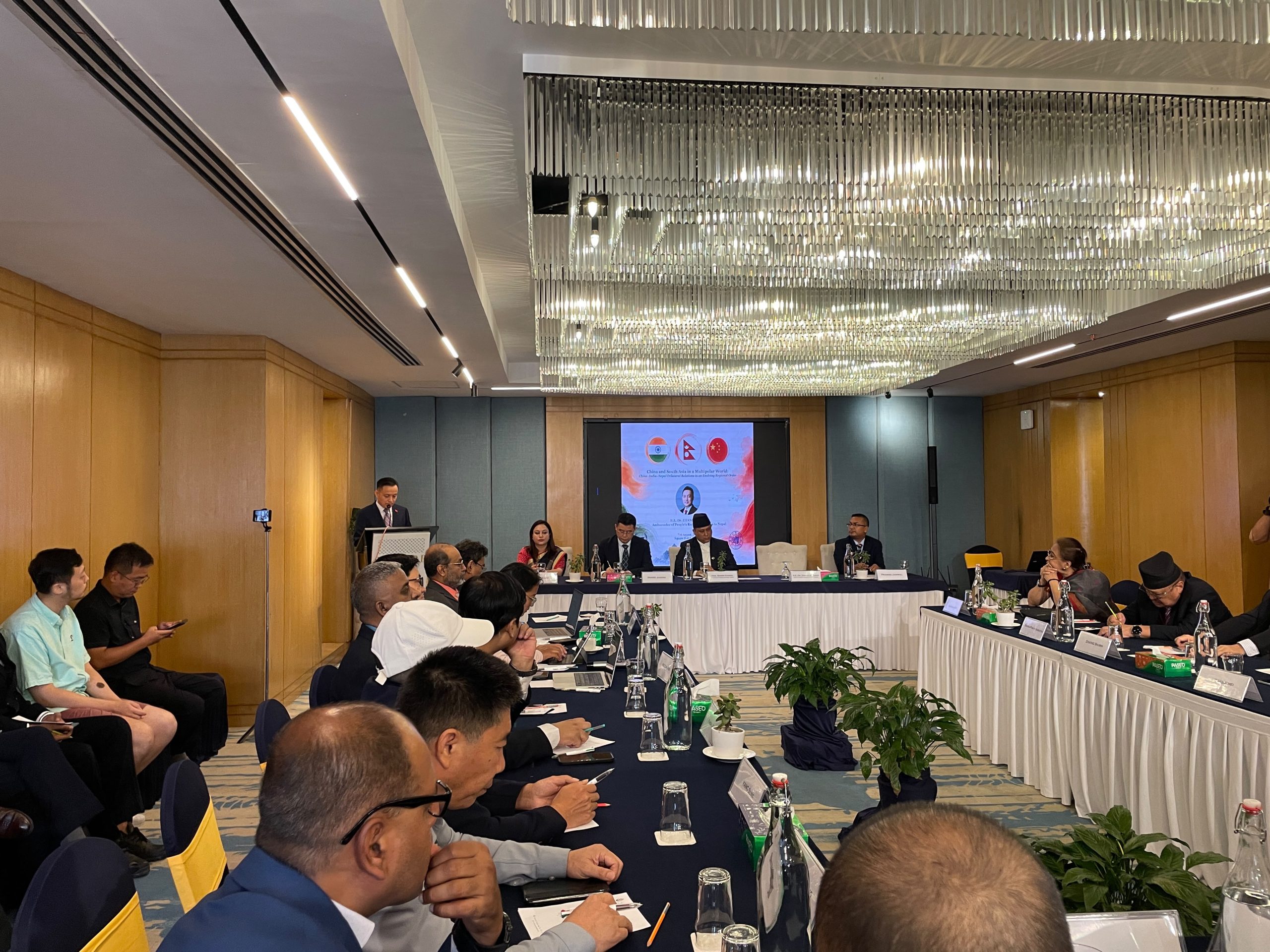

Kathmandu, August 7 A two-day international conference titled “China and South Asia in a Multipolar World”
commenced on 7 August at The Square Hotel, Pulchowk, Kathmandu, bringing together distinguished scholars and affairs experts from Nepal, China, and India to deliberate on the evolving geopolitical landscape of South Asia.

The conference is jointly organized by the Center for South Asian Studies, Fudan University, China, and the Nepal Institute for International Cooperation and Engagement (NIICE). The event aims to foster academic dialogue and policy discussions on regional cooperation with a focus on trilateral connectivity, security, and emerging challenges in an increasingly multipolar world. The conference brings together around 30 speakers and academics, diplomats, policymakers, researchers, and strategic affairs experts from Nepal, China, and India.
Addressing the inaugural session as the keynote speaker, Hon. Shisir Khanal, Minister for Foreign Affairs of Nepal, said that “Asia’s transformation presents unprecedented opportunities for shared prosperity” and emphasized that ‘South Asia possesses enormous promise, but much of its economic potential remains untapped. He stated that Nepal sincerely welcomes the continued development and prosperity of both India and China and remains committed to further strengthening its longstanding bilateral relations with both neighbours independently, on the basis of sovereign equality, mutual respect, mutual benefit, and sensitivity to each other’s legitimate interests and concerns.’
Khanal said that economic diplomacy has become one of the defining priorities of Nepal’s external engagement and stressed that Nepal’s foreign policy is about improving the lives of its people through trade, investment, employment, tourism, technology, innovation, and sustainable development. He further stated that Nepal aspires to transform itself from a landlocked country into “a vibrant, dynamic bridge connecting China and South Asia” by enhancing cross-border transport connectivity, trade facilitation, digital connectivity, and people-to-people exchanges.
Highlighting Nepal’s comparative advantages, he pointed to the country’s hydropower potential, rich biodiversity, tourism assets, and shared civilizational heritage with both China and South Asia. He underscored that the shared future of the region depends on building practical partnerships for shared prosperity through cooperation in trade, investment, connectivity, energy, technology, climate adaptation, research, and people-to-people exchanges. Concluding his address, he said, “The future of Asia will ultimately be determined not only by the size of our economies or the pace of technological change, but by the quality of the partnerships we build and the trust we cultivate,” adding that Nepal stands ready to play its constructive role in advancing shared prosperity and sustainable development.
Speaking at the inaugural session, H.E. Dr. Zhang Maoming, Ambassador of the People’s Republic of China to Nepal, emphasized that “In recent years, under the profound changes unseen in a century, old and new contradictions have intertwined. Regional conflicts have been erupting worldwide. Unilateralism, protectionism and hegemonism are on the rise, posing severe challenges to peace and development. International order has suffered unprecedented erosion, and the world is at risk of sliding back into the law of the jungle.”

Amidst all of this he noted that “Meanwhile, South Asia has maintained overall stability and sustained economic growth, emerging as an indispensable rising force in global power structure. The development of South Asia vividly reflects the advancing multipolarization of the world, and stands as a powerful testament to the advent of the ‘Asian Century.’” Highlighting Nepal’s strategic importance, he stated, “Nepal, as a vital bridge linking China and South Asia, plays an irreplaceable role in enhancing connectivity and practical cooperation across this important region.”
He further remarked that “2026 marks the launch of China’s 15th Five-Year Plan and the inaugural year of Nepal’s new government, which brings greater opportunities for deeper strategic alignment and integrated development between our two countries.” Stressing future cooperation, Ambassador Zhang said, “China stands ready to work with Nepal, to implement the important common understandings reached by our leaders, deepen high-quality Belt and Road cooperation and practical cooperation in various fields, and continue to carry out brand programs in poverty reduction, medical cooperation and people-to-people exchanges.” He added, “Our two countries are expected to set an example for bilateral cooperation among South Asian countries, and contribute to regional stability and prosperity.”
The inaugural session was chaired by Ms. Sumitra Karki, Director of NIICE, while Dr. Pramod Jaiswal, Research Director of NIICE, delivered the opening remarks and suggested the government of Nepal to consider establishing dedicated support mechanisms for independent think tanks working in areas such as foreign policy, strategic affairs, economic diplomacy, international trade and regional cooperation. He also advised that the Nepal government should promote Nepal Study centers in India and China.
Ms. Sumitra Karki, Director of NIICE highlighted that NIICE has organized robust discussions on Nepal China and India to promote deeper relations between Nepal and China as well as Nepal- India. She noted that the jointly organized conference reflects the two institutions’ shared commitment to promoting academic dialogue and policy engagement on regional affairs. She expressed confidence that the conference would generate meaningful discussions and strengthen scholarly cooperation among Nepal, China, and India on issues of regional significance.
The inaugural session concluded with a vote of thanks by Prof. Dr. Zhang Jiadong, Director of the Center for South Asian Studies at Fudan University, who began by expressing his sincere appreciation to the Hon. Minister of Foreign Affairs for his keynote remarks, praising important principles and highlighting the balanced relationship with all friendly countries including neighbors China and India. He noted that China and Nepal are friendly neighbors raised by mountains and rivers and partners founded by generations of friendship, mutual support and shared developments. He noted on Stress on economic diplomacy and to pursue a new style of diplomacy based on national interest. Referring to the idea of the “Asian Century,” Zhang argued that although the concept is not new, its contemporary significance has evolved amid major global changes. Citing the historical Trans-Himalayan cultural links among China, Nepal, and India, he emphasized that cultural affinity alone is insufficient and should be translated into practical regional cooperation. He described the conference as a valuable platform for scholars from the three countries to promote mutual understanding, bridge cognitive gaps, and identify shared interests.
The conference will feature eight thematic sessions over two days, covering issues including China and South Asia in a multipolar world, Nepal-China-India trilateral cooperation, bilateral relations among these countries, strategic competition & security, economic corridors and regional development, soft power and educational diplomacy, and Nepal’s internal dynamics and foreign policy.
Scholars and experts from leading institutions including Fudan University, Yunnan Academy of Social Sciences, Shanghai Institutes for International Studies, Hebei University of Economics and Business from China, Manohar Parrikar Institute for Defence Studies and Analyses (MP-IDSA), Jawaharlal Nehru University, Delhi University, FORE School of Management from India and former ambassadors of Nepal to China, Tribhuvan University, Lumbini Buddhist University, Policy Research Institute, and NIICE from Nepal are participating as speakers.
The conference will conclude on August 8, 2026.